
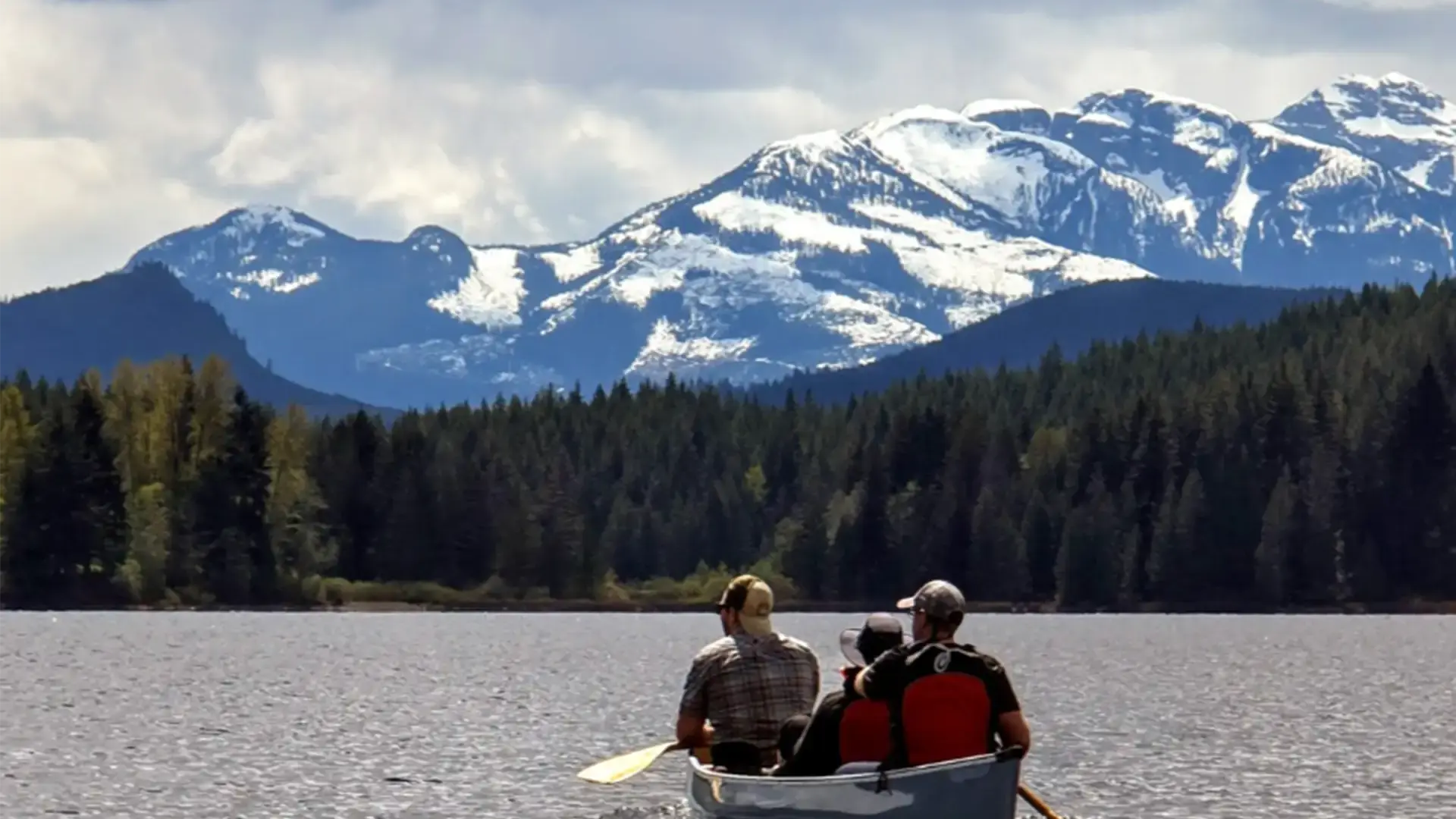
On our final morning in the Sayward Forest on Vancouver Island, a group of seasoned leaders sat quietly with waterproof journals in hand. No one spoke. There were no slides. No summary decks. Just the sounds of the lake, the wildlife, and the steady scratch of pen on paper.
These entrepreneurial leaders were putting the finishing touches on stories they were about to share around the fire. Not business updates or strategic plans, but declarations about who they intended to be.
I still think about that moment: a room of experienced leaders sitting in quiet concentration, each preparing to share the story that shaped how they lead. Another snapshot: A silent canoe paddle after a deep session about discovering one’s purpose. We all committed to two hours of silence until the next portage, moving steadily across open water while contemplating the topic, surrounded by people who genuinely had each other’s backs. It may sound simple, but boy was it powerful.
When There’s Nowhere to Hide
This was the True Life Story Expedition, a five-day wilderness journey for accomplished leaders that I co-led with Tom Benson. I’ve spent years working with senior executives at off-sites, in boardrooms, and in high-stakes communication moments. This experience was different. We weren’t focused on developing sharper delivery or greater confidence, but on how quickly and easily leaders can open themselves up to the stories they may be ignoring.
The leaders who joined us were high performing and accomplished. These were people who had built successful companies. They understood finance, operations, and growth. Many had families and financial security. From the outside, they were the modern definition of success.
What each of them sensed, however, was that something needed to shift. Not a tactic or a revenue stream, but something deeper. A question about whether the story they were living was one they had consciously chosen.
Most leadership development environments are designed to optimize performance. Programs, retreats, and coaching sessions help leaders sharpen thinking, communicate more effectively, and execute with greater clarity. That work matters. And I do that work myself. But those environments remain performance environments: you can leave the ballroom or return to your hotel room. You can reassemble your armour.
In the wilderness, that option disappears. The armour disintegrates.
There is no office, no inbox, no escape hatch. No social scrolling to escape to. You are sleeping in tents, lifting canoes, paddling for hours, and cooking over a fire. This physicality matters because when your body is engaged and your limits are stretched, your thinking shifts. There is less room for abstraction. You become present. And presence is the foundation of honest reflection.
The Work Beneath the Resume
We structured our days deliberately. We started early with reflective exercises designed to broaden perspective before we stepped into a canoe. Later, long stretches of paddling created space for conversation to unfold. Canoe partners rotated daily, so cliques never formed. Structured listening exercises required participants to truly hear one another. Evenings around the fire were reserved for synthesis and building toward the next day. Every day we moved to a new location, reinforcing that this was about progression rather than a static retreat.
The themes were not tactical. We challenged leaders to examine what truly matters, to explore the baggage they may have. To confront unfinished conversations and identify defining life moments while questioning whether those moments still get to define them. We invited them to articulate what their next chapter should look like and what actions would be required to make it real.
On the first day, some participants observed quietly. I remember one leader sitting quietly, holding back at the beginning. But by the end of that first day, he stood and declared, “I feel like I’ve been an impostor my entire life.”
That moment shifted the tone of the group.
Without the need to be polished or prepared, communication changed. Leaders spoke from the heart rather than from a script. There were admissions of doubt and conversations that would never have surfaced in a board meeting. Over time, what began as polite introductions evolved into deeply intentional dialogue. There was no positioning or subtle competition. Just collaboration and reflection. Through rotating partners and structured vulnerability, trust accelerated.
Narrative surfaced everywhere: through personal history, defining moments, and the realization that those moments do not have to permanently define you.
Many of these leaders had optimized the business side of their lives, but they had not examined how they see themselves or how that self-perception shapes their leadership and relationships. Once that awareness clicks, the shift can be profound.
Where Leadership Begins
Clarity emerged differently for each person. For some, it arrived suddenly through a single realization about how they needed to show up differently as a parent or as a leader in their company. For others, it built gradually over the week. By the final campfire, however, each participant stood and articulated the story they intended to live. Not perfectly or performatively, but consciously and tangibly.
That’s what felt distinct from most leadership programs. We were not just improving leadership skills. We were asking a more fundamental question: Who are you becoming?
Leadership development often talks about the journey. This was one. Literally. The physical movement mirrored the internal movement. The wilderness lowered defences. It removed distraction. It made connections easier and avoidance harder. This retreat was an experiment based on a long held belief that story sits upstream of leadership.
The same principle shows up in my executive communication work every day. When leaders struggle to land a message, align a team, or articulate a vision, the issue is rarely vocabulary or structure alone. More often, it’s that the underlying story they are leading from is unclear. When the story around identity sharpens, communication follows.
When the Story Is Clear
The narrative a leader carries about themselves shapes how they make decisions, how they communicate, and how they show up in moments that matter. When that story is outdated or unconsciously inherited, communication work is incomplete. You can polish the message and refine the slide, and, yes, those skills absolutely matter. But if the underlying narrative is misaligned, something still feels off. People will smell it a mile away.
When leaders consciously choose their narrative, something steadier emerges. Decisions become more coherent. Communication becomes more grounded. And teams sense alignment, often before it is explicitly stated.
Participants described the True Life Story Expedition experience as a reset, “a return to the foundational things that matter.” They spoke about choosing which parts of themselves to carry forward and which to leave behind. More than once, someone called it a “profound investment of just a few days.”
I wasn’t dramatic. There were no fireworks, trust falls, or manufactured breakthroughs. There was simply a group of accomplished leaders moving through the wilderness, sitting in silence, lifting canoes, listening deeply, and doing the work of re-authoring the story they intended to live.
Sometimes the most important leadership declaration is not delivered from a stage.
It is written quietly, by hand, beside a lake.
If this kind of work resonates with you, I’m always open to a thoughtful conversation. The True Life Story Expedition is intentionally small and curated, and future editions will be announced later in 2026. If you would like to hear about them, feel free to reach out directly.
I’m grateful to co-lead this experience alongside Tom Benson, whose perspectives and presence shape the work in ways that matter deeply.
And if the deeper intersection of story, identity, and leadership is something you’re thinking about more broadly, I explore those ideas regularly in my newsletter, The Narrative Shift. It’s a place for clearer thinking, better questions, and practical insight into how narrative shapes leadership long before a message is delivered.
Subscribe Here